Honored to contribute to the ABA’s Judge’s Journal – one of the nation’s foremost judicial journals and the authoritative source on innovations in the justice system. Read my essay about the need for a strong and independent immigration court.
Pressure, pushing down on me,
pressing down on you.
—David Bowie & Freddie Mercury
For over eight years, I sat on the bench in the San Francisco Immigration Court, presiding over removal and bond hearings of noncitizens. At the start of each hearing, I introduced myself to the parties as Judge Jeremiah Johnson, adding that “I was in charge here.” But was I really in charge of these proceedings? Did I truly have judicial independence? All judges, including immigration judges, work under tremendous pressure. Caseloads can be demanding, and testimonies can be wrenching. On top of this, immigration judges are unique in that they are not covered under the constitutional protections established for an independent judiciary. The federal judiciary is a separate and equal branch of government. The immigration court system is not. Rather, it is a regulatory construct housed within the executive branch. Still, immigration judges have struggled to maintain independent decision-making authority and found protection under the Civil Service Reform Act and the guiding principles of due process and the rule of law. Today, however, the mounting pressures and hard power exercised by the executive require us to rethink whether these protections are sufficient to ensure due process.
The American political scientist Joseph Nye coined the phrase soft power to describe the ability to influence through persuasion rather than using hard power, i.e., coercion or military force. Within the immigration court structure, the executive’s hard power to achieve a particular result is constrained by an immigration judge’s independent judicial decision-making authority. In other words, the executive can neither order nor instruct an immigration judge to deny or grant a case. However, the unavailability of hard power to control immigration judge decisions does not prevent the executive from exercising soft power. From the immigration judge’s perspective, the exercise of soft power is felt as what I described as “soft pressure.” From the inception of the immigration court system, immigration judges worked under soft pressures, cultural attitudes about relief, and about specific types of claims. And those attitudes toward relief and claims would constantly shift. During my time on the bench, I was never directed on how to rule on a case. That is not to say that I did not experience pressure, but that pressure remained in chambers and did not spill over onto the bench. Now, however, the executive’s soft pressure has hardened, and guidance looks more like directives.
It should go without saying, but I will say anyway—immigration judges are real judges. Immigration judges preside over hearings involving one of the more complex areas of law. They perform judicial functions. They hear courtroom handles on motions, issue pre-hearing orders, maintain a courtroom, and make findings of fact and conclusions of law. If it looks like a duck, swims like a duck, and quacks like a duck, then it probably is a duck. However, as noted above, the immigration courts are housed within the executive branch, not the judiciary. Before the 1890s, immigration enforcement was left to individual states. In 1891, Congress enacted the Immigration Act of 1891 thereafter federalizing immigration enforcement. This act of Congress created a Board of Special Inquiry within the Department of the Treasury to determine who to admit and who to remove from the United States. The Board’s decision was subject to appeal and ultimately reviewable by the secretary of the Treasury. The framework for the modern immigration court system was born.
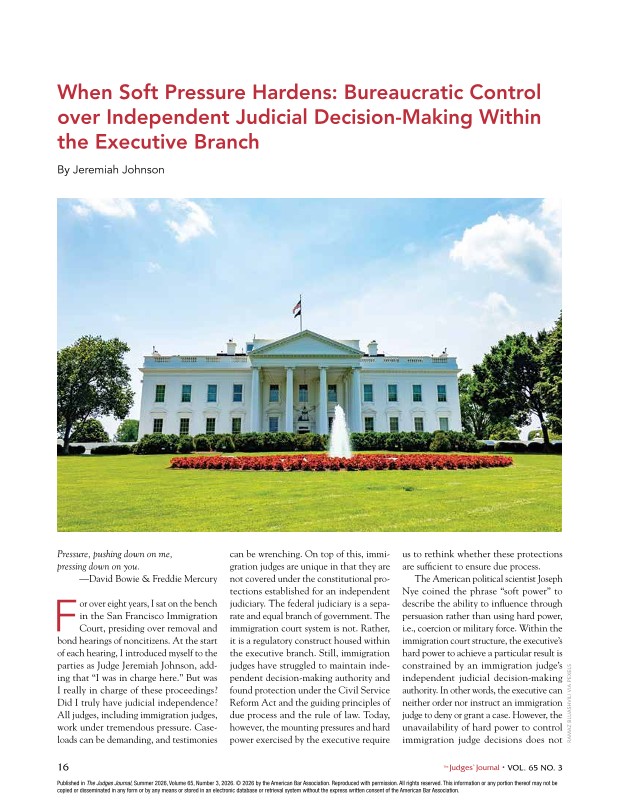
In the 1940s, immigration matters were transferred from the Department of the Treasury to the Department of Justice. With the enactment of the Immigration and Nationality Act in 1952, special inquiry officers assumed the functions of the inquiry boards. In 1973, regulations first adopted the term “immigration judges” for the special inquiry officers, nevertheless, these new “judges” were still answerable to the attorney general. In 1983, the attorney general created a new government bureaucracy—the Executive Office for Immigration Review (EOIR)—to “improve the management, direction and control of the immigration judicial review program.” Today, the immigration court system looks like this: Immigration judges answer to assistant chief immigration judges, who answer to regional deputy chief immigration judges, who answer to a chief immigration judge, who answers to a deputy director, who answers to a director, who answers to the deputy attorney general, who answers to the attorney general, who answers to the president of the United States. Although the bureaucratic road is long, it clearly leads to 1600 Pennsylvania Avenue.
Immigration judges are actually attorneys employed by the Department of Justice and appointed by the attorney general to serve as an administrative judge. They are not Senate confirmed, rather immigration judges are selected through a competitive hiring process—an application, multiple interviews, and the like. They are government employees, and until recently, immigration judges had been considered to fall under the protections of the Civil Service Reform Act. Within this structure, the attorney general could exert soft pressure through bureaucratic control to align individual immigration judge decisions with political goals. Bureaucratic control employs hierarchical structures, standard operating procedures, and performance metrics to increase efficiency and reach predictable results. At first glance, this does not appear as a bad approach for a court system burdened with a 3-million-case backlog, but when the attorney general uses this control to further a political agenda, independent judicial decision-making falls victim.
Within the immigration court system, the attorney general not only can employ soft pressure to affect immigration judge decisions, but the attorney general does have the hard power to issue binding nationwide precedent. Individual immigration judge decisions may be appealed to the Board of Immigration Appeals, an appellate body within EOIR. Some of the Board’s decisions may be published and form the body of binding case law that immigration judges must follow. The attorney general also plays a role in this process. Specifically, the Attorney General has the authority to step in, review a case, and issue a binding nationwide precedent in all proceedings involving the same issue or issues. Combined—soft pressure and hard power—gives the attorney general tremendous power over the immigration court system, and the judges who preside over court proceedings.
In 2018, I witnessed this combined approach firsthand at the annual in-person immigration judge conference. Then Attorney General Jeff Sessions addressed the audience of judges, declaring the end of lawlessness. Prefacing his remarks that the vast majority of asylum claims are not valid, he indicated that he will be issuing a binding precedent decision to end the perceived abuse of asylum. In the same address, the attorney general remarked that volume is critical. The next day, true to his word, the attorney general issued Matter of A-B-, a pivotal case overturning existing Board precedent that recognized gender based asylum claims. Elsewhere at the conference, EOIR announced performance measures and a quota system for judges. Recalling the words of the Roman commander in Ben Hur, one immigration judge remarked, “Row well and live.”
With this in mind, immigration judges returned to their courtrooms to meet volume and work the assembly line of justice. Assembly line justice refers to a system that prioritizes speed over deliberative decision-making. Assembly line justice can create rushed hearings, or, as it were, even no hearings at all. Debate surrounds the use of assembly line justice in low-level misdemeanors, and immigration judges have always strived for efficiency under the strain of a demanding caseload. At the same time, volume was receiving top billing. EOIR management began exercising greater levels of control over individual case assignments and dockets. For example, in May of 2018, the attorney general issued Matter of Castro-Tum, effectively ending the long-established practice of the use of administrative closure as a tool to allow immigration judges to manage their dockets. The attorney general remanded that specific case to the immigration judge for further proceedings, and when the judge who had been hearing the case granted the noncitizen a continuance to obtain counsel rather than order their removal, EOIR reassigned the case to a different judge. The attorney general had achieved a particular outcome in a specific case. With the introduction of quotas and case assignments, existing structural soft pressures were beginning to harden. As Judge Ashley Tabadoor, then president of the National Association of Immigration Judges, said, “We have quotas and deadlines, we have judges being removed from cases because the Justice Department is not happy with the decisions that they’re making. . . . That kind of interference with the decision-making authority of the judges is frankly unprecedented.”
While these kinds of interference may have seemed unprecedented at the time, the genesis of court interference lies in the structure created by Congress and exercised by Democratic and Republican administrations alike. To be clear, immigration judges have always faced pressure from multiple administrations regardless of party. What immigration judges are now facing is a hardening of that pressure.
In January 2025, the EOIR director issued a policy memorandum to all of EOIR to “recommit to EOIR core values and the rule of law,” threatening adjudicators who choose not to adhere to the law risk corrective or disciplinary action. Fair enough, laudable on its face if not ominous in tone. Then in February 2025, the director issued another policy memorandum indicating that EOIR may not recognize civil service protections for immigration judges. The following Friday in February, the director issued another policy memorandum questioning the legality of the hiring of immigration judges in the past administration and placing precedential blame of firing judges on the past administration, while at the same time indicating that EOIR will continue that practice of firing judges. Then, in March, another policy memorandum indicated that all terminations will be forwarded to the attorney general for concurrence. Another week, another policy memorandum, this time the director accused “some Immigration Judges” of bias and that they should consider alternative career paths. Addressing immigration judge independence, the Director indicated that EOIR would take “closer examination” of “[a]djudicatory outliers or statistically improbable outcome metrics” (i.e., judges) and take “potential action” to root out “systemic bias or failure to adhere to applicable law.” And just to be clear, potential action means:
removal by the Attorney General exercising executive authority enshrined in Article II of the Constitution on behalf of the President. See, e.g., Collins v. Yellen, 594 U.S. 220, 256 (2021) (“The President must be able to remove not just officers who disobey his commands but also those he finds negligent and inefficient, those who exercise their discretion in a way that is not intelligent or wise, those who have different views of policy. . . and those in whom he has simply lost confidence.” (cleaned up)).
All in all, the director issued a staggering 51 policy memorandums in 2025. Gone were the occasional traditionally simple bureaucratic directives written in legalese, replaced with the near-weekly spicy tirades against the former administration. Indeed, the director took great pains to blame the past, while forecasting a series of steps that would ultimately weaken, not strengthen, judicial independence. Still, each policy memorandum signed off with a near-identical boilerplate that “[n]othing in this PM limits an adjudicator’s independent judgment and discretion in adjudicating cases or an adjudicator’s authority under applicable law.” In the words of Hamlet, the director “doth protest too much, methinks.”
Despite any protestations to the contrary, EOIR has taken direct action to achieve particular outcomes in specific cases. As mentioned above, EOIR reassigned Castro Tum’s case to a different immigration judge to achieve a particular outcome. Another more recent example is the May 30, 2025, email from the regional deputy chief immigration judge providing “guidance” on adjudicating specific motions to dismiss or terminate. That email prompted a lawsuit supported by a declaration from an immigration judge indicating that an assistant chief immigration judge directed the judge to grant the motions. In response, the director issued another policy memorandum withdrawing the email with the understanding that no competent immigration judge would have understood the directive from above as a directive to decide a case a particular way. As of the date of the email, 25 immigration judges had been fired without explanation.
Another example of direct action EOIR has taken to achieve a particular outcome in specific cases is how EOIR addressed jurisdiction over bond proceedings. As the highest court in the land reminds us, “[i]t is familiar law that a federal court always has jurisdiction to determine its own jurisdiction.” However, the immigration courts are not housed in the federal judiciary. Taking advantage of this structural weakness, the chief immigration judge sent an email directing assistant chief immigration judges to issue guidance to immigration judges that a Board of Immigration Appeals addressing a bond jurisdiction case remains binding precedent on immigration judges despite a District Court order vacating that Board decision. If immigration judges were actually allowed to exercise their independent decision-making authority, they could reach that decision themselves. Or, they could have decided the opposite. The point being, immigration judges should have had the authority (and independence) to make that determination themselves, and either party would have been able to appeal the judge’s decision if they disagreed. That is how an independent judicial system operates, not through emails offering “guidance” on a particular outcome to achieve a particular result. When EOIR emailed the guidance, over 100 judges had been fired without explanation.
And just to be clear about the intentions of the Executive—on November 21, 2025, the Department of Justice posted a job advertisement for “deportation judges.” The advertising campaign was promoted by the Department of Homeland Security (a party to the proceedings before immigration judges) and included a meme of the fictional Judge Dredd, who served as judge, jury, and executioner. This not-too-subtle nod to the executive’s hardline, sweeping mass-deportation policy agenda offered applicants the opportunity “to be the judge” with signing bonuses and the possibility of remote work. On the same day that the executive advertised for “deportation judges,” I was fired without explanation.
If the above gives you pause to think, EOIR’s crushing caseload and docket management provide little opportunity for immigration judges to do the same, which is integral to ensuring maximum pressure on immigration judges. To be sure, case management is a form of soft pressure with bureaucratic control in full display. Retired immigration judge Paul Schmidt describes the practice of “aimless docket reshuffling” from one administration to the next, causing backlogs, wasted resources, and due process concerns. The inevitable bureaucratic inefficiencies that accompany consistently changing priorities, leading to scheduling and rescheduling of cases, not only cause delays but also create case uncertainty. Throughout my time on the bench, I have prioritized juvenile dockets, family dockets, recent arrivals, and aged cases. When each new docket becomes a priority, other priorities tend to take a back seat, and priorities do not remain priorities for long. This docket management is now on overdrive, and appears to have a different motivation and effect. Some priority dockets are forecasted by political messaging, as was the case with the recent “Somali Rocket Docket.” Other dockets are introduced by EOIR administrators and given titles like “Operation Tardis,” an apparent reference to the similarities of the booths that detained noncitizens would enter to appear before an immigration judge and the fictional time/space machine from the British science fiction series Dr. Who. Now there are “mega masters”—hearings with over 100 individuals appearing during one calendar slot, creating serious operational, logistical, and security concerns. Under current EOIR management, the assembly line just got a little bit faster.
Speed and volume, combined with soft pressures, must be by design. The policy memorandum forecasting firings, EOIR direct actions to achieve a particular result, and docket management on overdrive, when viewed together, reveals an immigration judge corps under incredible executive pressure. Still, immigration judges worked long hours and through lunch, able to exercise their independent decision-making authority, knowing they were under the umbrella of protection afforded by the Civil Service Reform Act. Until now. In 2025 alone, the attorney general fired over 100 immigration judges without stating a cause. As pointed out by one of the 51 policy memorandums, firing an immigration judge is not unprecedented. What is, however, the sheer number and manner of the firings.? Notice can come in the form of an email at the end of the day or a tap on the shoulder mid-hearing. And immigration judges have not been told that their performance was deficient in any way; rather, the message is delivered in a chilling letter—“pursuant to Article II of the Constitution, the attorney general has decided to remove you from your position as an excepted service Immigration Judge with the U.S. Department of Justice, Executive Office for Immigration Review.” Moreover, not only does the individual immigration judge not know the reason for their termination, but the existing immigration judge corps is left guessing what is or is not acceptable performance. Judges are looking over their shoulders, and the attorney general is finally exercising hard power over immigration judges—the power over a person’s livelihood.
Over 200 years ago, Alexander Hamilton wrote that “a power over a man’s subsistence amounts to a power over his will.” Although this statement was made in support of the separation of powers and the establishment of an independent judiciary, this founding message still rings true today. The law requires fidelity, the executive requires loyalty. If immigration judges must rely on the attorney general for their pay, would they inevitably bow to executive pressure? Publius would undoubtedly answer yes.
Originally published in The Judges Journal, Summer 2026, Volume 65, Number 3, 2026. © 2026 by the American Bar Association. Reproduced with permission. All rights reserved. This information or any portion thereof may not be copied or disseminated in any form or by any means or stored in an electronic database or retrieval system without the express written consent of the American Bar Association.
 Johnson Law & Consulting
Leave a comment