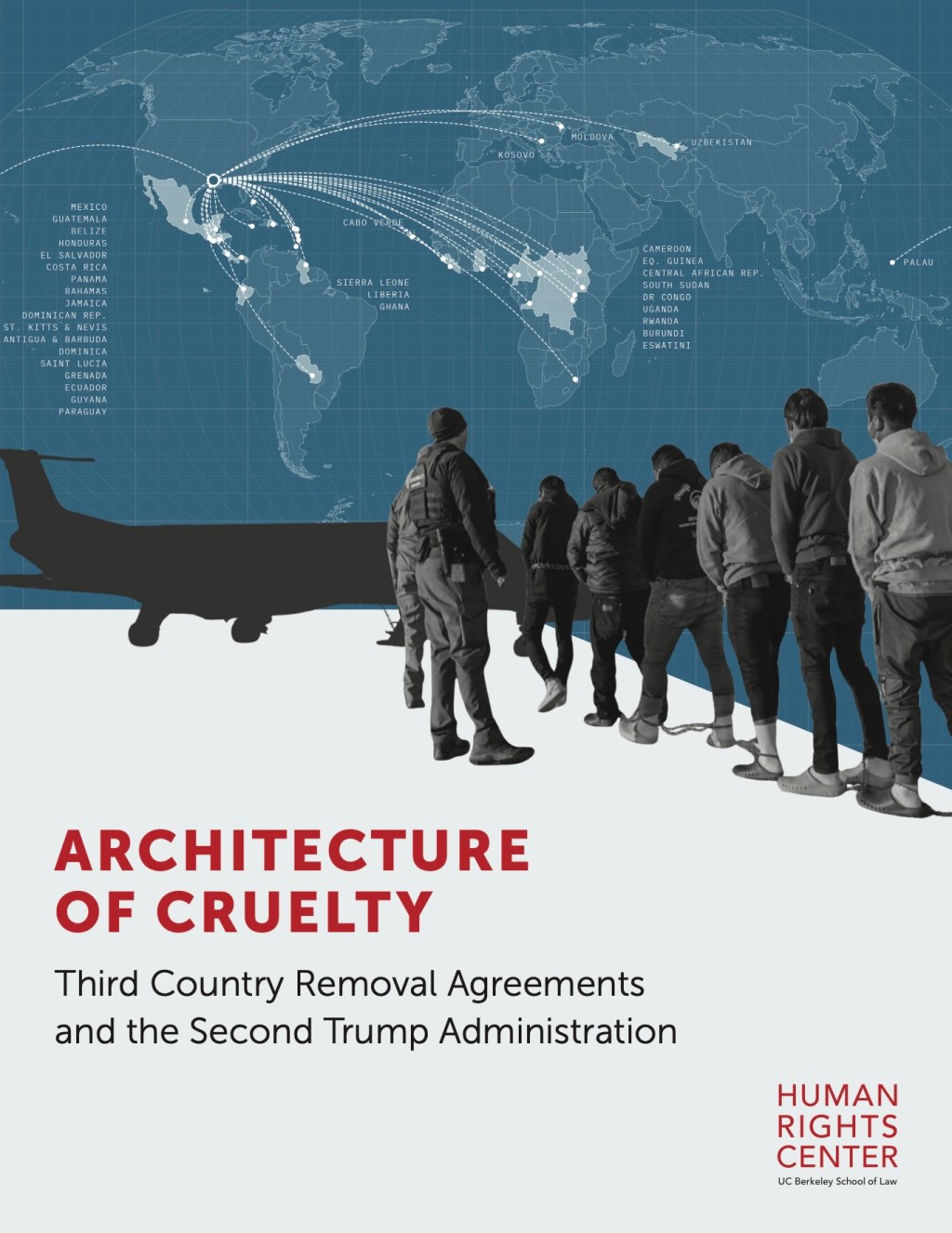
Read my foreword to UC Berkeley School of Law Human Rights Center’s newest report, Architecture of Cruelty, Third Country Removal and the Second Trump Administration.
STEPPING OFF THE BUS, I expected to see migrants heading north. I had arrived in Tapachula, Mexico — right near the border with Guatemala and the
largest migrant gateway to Mexico and El Norte. The first migrants I met in Mexico were Cuban nationals who had recently been deported from the United States. First country, second country, now a third country. Carlos, Yordan, Alex, and Jaimie were not heading anywhere. They were just waiting, so I waited with them and thought, “Well, this isn’t how it’s supposed to be.”
While I waited, I learned that most of the Cuban nationals transported to Mexico were long term residents of the United States. Some had served time
in US prisons; others struggled with mental health issues; most had come to the United States as children in the 1980s. Because of U.S. policy towards
Cuba, no agreements had been enacted to facilitate the return of Cubans to Cuba. So many Cubans were living out their lives in the United States, with a required check-in annually with an immigration officer.1 None of these men were in Mexico by choice. Most of them had been arrested at their annual
check-in. All of them had been forcibly removed by the United States to this third country.
I was on a journey to see for myself what was happening in Central America. Several months before, I had granted asylum to a Guatemalan family.
After that hearing ended, I was fired.
• • •
For the past eight years I served as an immigration judge at the San Francisco Immigration Court. Over those eight years, I heard thousands of claims for refugee protection in the United States. Standing before me were men, women and children seeking asylum, withholding of removal, and protection under the United Nations Convention Against Torture. The law was explicit: immigration judges shall conduct removal hearings, and I was an immigration judge.2 I conducted hearings first to determine removability and then to decide if the person was eligible for relief from removal. The first determination, in general, was routine: it is uncontested that a person is in the U.S. unlawfully when they enter without documents or overstay a nonimmigrant visa. Nevertheless, they also are eligible for various forms
of protection that enable them to remain in the U.S. That was the essence of my job — deciding if the individual or family before me would be able to remain in the United States.


Leave a Reply